BlogMusic Discovery
Why Spotify Discover Failed for DJs (and what we built instead)
Every DJ I know keeps the same graveyard on their account: a Spotify Discover playlist they stopped opening months ago. This is the story of why the algorithm kept missing for me, and what my co-founder Marc and I built in Mainz after one too many dead-end digging sessions.
 Antonio Haas9 min read
TL;DR
DigDeeper is an audio-similarity search engine for DJs and crate-diggers. You drop in a reference track and get up to 100 tracks that actually sound like it — ranked by sound, not genre tags or popularity. It exists because Spotify Discover Weekly is built for casual listening, and the algorithm won't show you the underground cuts a DJ set is made of.
On this page
Every DJ I know keeps the same graveyard on their account: a Spotify Discover playlist they stopped opening months ago. This is the story of why the algorithm kept missing for me, and what my co-founder Marc and I built in Mainz after one too many dead-end digging sessions.
The moment I stopped trusting Discover Weekly
A few years back I was prepping a set I wanted to record and upload — one continuous sound across the whole thing, deep funky house with rolling basslines, nothing that broke the vibe. So I did what I always did: I opened Discogs and Bandcamp and started working through labels and buyer profiles, track by track.
Eight hours. Roughly a hundred tracks auditioned. Maybe five or ten were decent. Two were good enough to actually play. That was a normal session, not a bad one.
Somewhere in the middle of it I flipped over to Spotify Discover Weekly, hoping it would shortcut the grind. It handed me a mainstream house anthem I'd already heard a thousand times. Technically "related." Completely useless for what I was doing.
That was the moment it clicked: this thing was never built for me. It's built to keep a casual listener happy on a Monday commute — and it's genuinely brilliant at that. It just has no idea what a DJ set actually needs, because it can't hear the track I'm holding.
Why the Spotify algorithm can't hear a track
Here's the structural part, and I want to be fair to Spotify: Discover Weekly is loved by millions for a reason. But under the hood it runs mostly on collaborative filtering — it recommends tracks that listeners with a similar history already played. That approach has a well-documented blind spot: popular items are easy to surface, and obscure or brand-new ones are hard, because there simply isn't enough behavioral data attached to them.
For house and techno DJs, that blind spot is the whole job. The tracks that make a set yours are the deep cuts — the slept-on, criminally underrated release from a label nobody's talking about, often sitting on a few hundred plays. Those are exactly the tracks a popularity-based system can't see. I found some of my favorite records that way, cuts sitting on 300 or 400 views that nailed my taste perfectly, and no spotify recommendations engine was ever going to route me to them.
The problem with Spotify Discover Weekly is that it optimizes for behavior, not sound. It knows what people did, not what a track is. And the crate-digging community feels it:
"Spotify's algorithms generally push a lot of the same songs to everyone"
— r/DJs
"it all sounds the same"
— r/techno, on everything landing in the same tempo band
DigDeeper analyzes audio, not metadata. That one difference is the entire reason it exists.
What crate-diggers actually need
Watch how a digger actually works and it's never a search box and a list. It's a tree. You find one track, you go to the artist, from the artist to the label, from the label to other releases, sometimes to the profiles of other people who bought the same record. One good find becomes a trail that branches.
The reason that manual trail is so painful is that the tools underneath it are sorted by the wrong thing. Genre tags are broken for this — labels routinely tag everything they upload with the same three genres, so "electro" ends up meaning nothing. Nobody's searching for a genre. They're searching for a sound they can already hear in their head but can't quite put into words. One DJ I interviewed said it plainly: he just wanted to search by sound instead of by artist and title.
There's a comment I keep coming back to, because it reframes the whole thing:
"A good DJ set - the best curated music discovery format ever created"
— r/electronicmusic
That's the bar. A set is one to three hours chosen by someone with taste, sequenced so each track sets up the next. No behavioral algorithm gets near it. If you're mapping the wider landscape, it's worth reading our 7 best Spotify alternatives for DJs — but the deeper problem isn't which app you're on. It's that none of them let you search the way you actually dig. (More on the day-to-day tactics in our upcoming guide on how to find new music as a DJ.)
How DigDeeper works
So Marc and I built the thing we wanted.
DigDeeper is an audio-similarity search engine for DJs and crate-diggers. You drop in a reference track — a YouTube, SoundCloud or Bandcamp link, or a track from the catalog — and a deep-audio model analyzes it: rhythm, bass weight, drum patterns, harmonic texture, atmosphere. Then it returns up to 100 tracks that sound like it, each with a similarity score from 0 to 100%.
Unlike Spotify Discover, DigDeeper analyzes the actual audio of a reference track, not the behavior around it. Because it matches on sound rather than tags or era, a 1994 jungle cut can come back next to a 2024 release — something no genre filter would ever put together. If a URL isn't already indexed, it gets analyzed on demand in about 10–30 seconds.
Under it sits a catalog of more than 10 million tracks, aggregated across Traxsource, Bandcamp and Discogs plus vinyl sources like Decks.de and Deejay.de — so an artist's records show up in one place instead of scattered across ten tabs with no player. On top, the filters DJs actually care about: BPM range, key via the Camelot wheel for harmonic mixing, track length or digital vs vinyl.
Digging deeper: track, artist, label
The part I'm proudest of is what happens after a good find. From any track, you can go three ways:
- Dig This Track — the 100 closest matches in the whole library.
- Dig This Artist — everything else that artist has done, ranked by how close it sounds to the track you liked.
- Dig This Label — the label's full catalog, ranked by similarity too.
That last one fixes something that always frustrated me. Labels release wildly diverse stuff, so "check the label" usually means wading through releases that share a logo and nothing else. Ranking a label's output by sound cuts straight to the parts that match the vibe you're chasing.
And because the matching is acoustic, it surfaces connections the scene doesn't have. There might be a label in São Paulo making exactly your sound with zero link to the ones you already follow — no shared artists, no shared buyers, nothing an algorithm-free map of the underground would ever connect. Audio similarity makes it visible anyway. That's how underground DJs build a sound nobody's playing yet, and stay recognizable for it.
What changed for me
I still dig every week. The difference is that it's a search now, not a lottery. Prepping a set around one specific texture used to eat days; now it starts from one reference track and branches from there.
FAQ
Why is Spotify Discover Weekly bad for DJs? It isn't bad — it's built for casual listening. Discover Weekly runs mostly on collaborative filtering, recommending what listeners with similar histories played. That favors popular tracks and starves the underground cuts a set needs. For crate-diggers chasing one specific sound, the spotify algorithm is optimizing for the wrong thing.
What's the alternative to Spotify Discover Weekly for finding underground tracks? A search that listens to the audio itself. DigDeeper is an audio-similarity search engine: drop in a reference track and get up to 100 that sound like it, ranked by sound rather than genre tags. It reaches the deep cuts, obscure electronic music and B-sides that popularity-based spotify recommendations never surface — and producers use it the same way to hunt down reference tracks.
How does DigDeeper work differently from Spotify? Unlike Spotify Discover, DigDeeper analyzes the actual audio of a reference track — rhythm, bass weight, drum patterns, texture, atmosphere. There's no behavioral model guessing your taste from what you played. You pick the reference, it finds the matches. DigDeeper analyzes audio, not metadata, so a 1994 cut can match a 2024 one.
Can I use DigDeeper for free? Yes. Three searches, no signup and no card. Sign in and you get five a month, plus a 14-day trial with unlimited searches that never asks for a card and never auto-charges. After the trial you drop back to the free tier. Pro is €9.99/month for unlimited digging.
What genres does DigDeeper work best for? It's built for electronic music, so it's strongest across house, deep house, tech house, techno, dub techno, electro, UK garage, breakbeat and jungle/drum & bass. Because it matches on sound instead of tags, it's especially good at connecting niche, cross-era tracks that genre labels would otherwise keep apart.
Try it on your next set
Drop in a reference track and see what comes back — try DigDeeper free, three searches, no signup required. Or start your 14-day trial for unlimited audio-similarity searches. No card, ever.
Frequently Asked Questions
Why is Spotify Discover Weekly bad for DJs?
It isn't bad — it's built for casual listening. Discover Weekly runs mostly on collaborative filtering, recommending what listeners with similar histories played. That favors popular tracks and starves the underground cuts a set needs. For crate-diggers chasing one specific sound, the spotify algorithm is optimizing for the wrong thing.
What's the alternative to Spotify Discover Weekly for finding underground tracks?
A search that listens to the audio itself. DigDeeper is an audio-similarity search engine: drop in a reference track and get up to 100 that sound like it, ranked by sound rather than genre tags. It reaches the deep cuts, obscure electronic music and B-sides that popularity-based spotify recommendations never surface — and producers use it the same way to hunt down reference tracks.
How does DigDeeper work differently from Spotify?
Unlike Spotify Discover, DigDeeper analyzes the actual audio of a reference track — rhythm, bass weight, drum patterns, texture, atmosphere. There's no behavioral model guessing your taste from what you played. You pick the reference, it finds the matches. DigDeeper analyzes audio, not metadata, so a 1994 cut can match a 2024 one.
Can I use DigDeeper for free?
Yes. Three searches, no signup and no card. Sign in and you get five a month, plus a 14-day trial with unlimited searches that never asks for a card and never auto-charges. After the trial you drop back to the free tier. Pro is €9.99/month for unlimited digging.
What genres does DigDeeper work best for?
It's built for electronic music, so it's strongest across house, deep house, tech house, techno, dub techno, electro, UK garage, breakbeat and jungle/drum & bass. Because it matches on sound instead of tags, it's especially good at connecting niche, cross-era tracks that genre labels would otherwise keep apart.
Written by
Antonio Haas
Digging electronic music since he was 16, house DJ (as Tonee) on vinyl and digital, co-founder of DigDeeper.
Search by sound
Drop a track you love. Hear what else sounds like it.
DigDeeper listens to the actual audio and finds the tracks that sound most similar.
Try DigDeeper FreeKeep digging
DJ Tips
Why Shazam Fails at Electronic Music (And What to Do When It Does)
Shazam fails on DJ mixes, unreleased tracks and white labels — here's why the algorithm can't help, what DJs do instead, and how to keep digging after the ID.
12 min read
DJ Tips
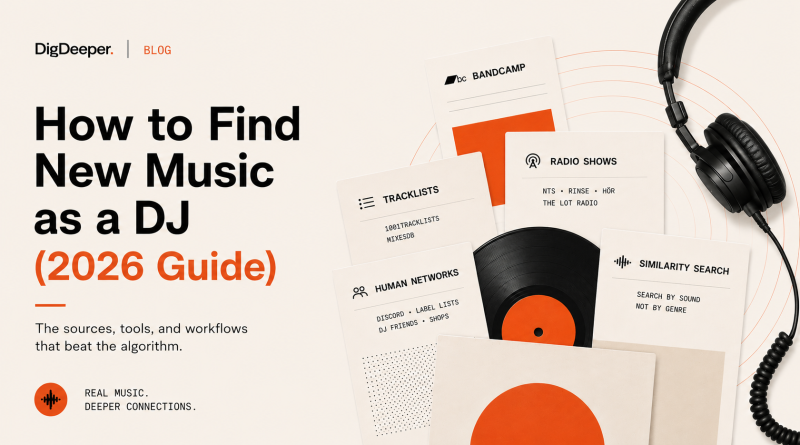
How to Find New Music as a DJ (2026 Guide)
How working DJs actually find new music in 2026 — the sources, tools, and workflows that beat the Spotify algorithm.
13 min read
Comparisons
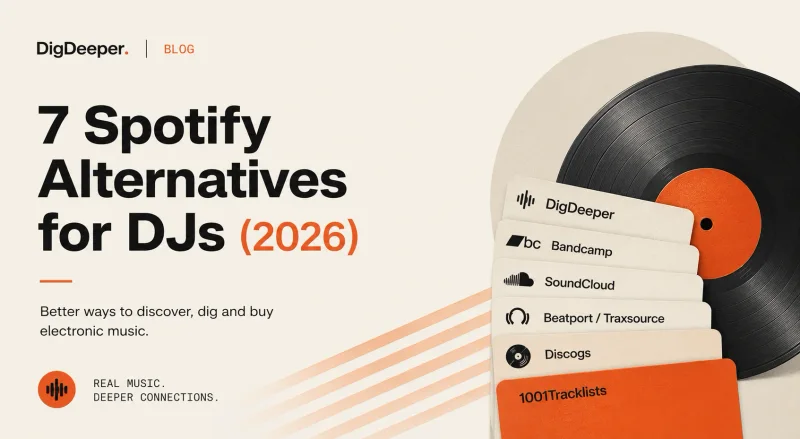
7 Spotify Alternatives for DJs (2026)
Spotify's algorithm wasn't built for DJs. Seven alternatives for finding electronic music: audio-similarity search, Bandcamp digging, vinyl archives. Tested in 2026.
13 min read