BlogDJ Tips
How to Find New Music as a DJ (2026 Guide)
How working DJs actually find new music in 2026 — the sources, tools, and workflows that beat the Spotify algorithm.
 Antonio Haas16 min read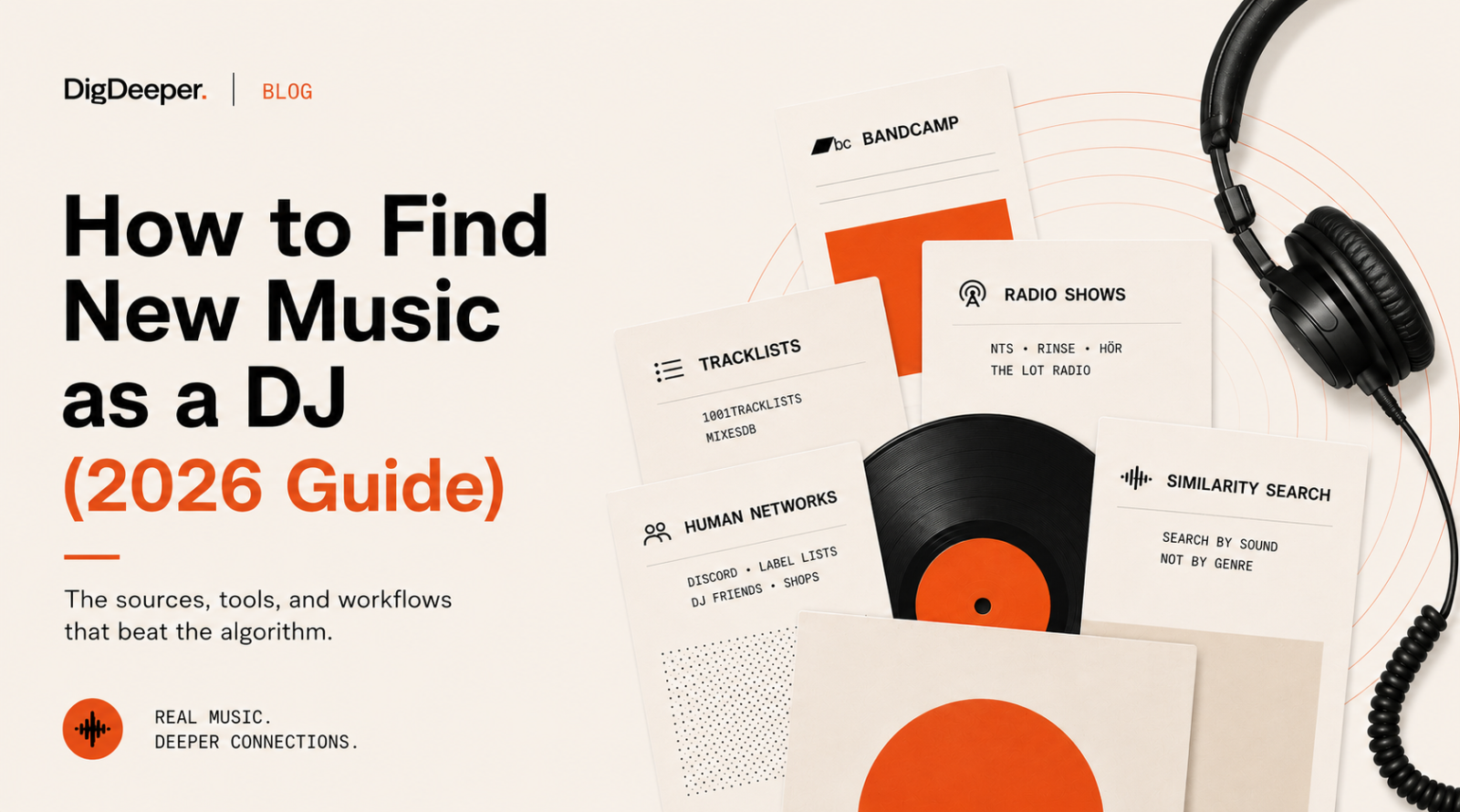
TL;DR
DJs find new music through five main routes:
- Specialist stores — Bandcamp, Beatport, Traxsource, Boomkat and Bleep, where releases are picked by humans rather than ranked by plays.
- Radio shows and recorded sets — NTS, HÖR Berlin, Rinse FM and The Lot Radio, where a selector's taste does the filtering.
- Tracklist databases — 1001Tracklists and MixesDB, which turn any set you love into a shopping list.
- Human networks — Discord servers, label mailing lists, DJ friends and record shop staff.
- Similarity search — tools that match tracks by how they actually sound instead of by genre tag.
Most working DJs run three or four of these in parallel. No single source covers everything.
On this page
- Why Finding New Music Got Harder in 2026
- Specialist Stores and Label Feeds
- Radio Shows and Recorded Sets
- Tracklist Databases: Turning a Set Into a Shopping List
- Human Networks: Discord, Friends, Record Shop Staff
- Similarity Search: Finding Music by Sound
- Record Pools: Volume Over Selection
- Physical Crate-Digging and Discogs
- Three Digging Workflows That Work
- 1. The Midweek Prep Session (90 minutes)
- 2. Digging Into a Genre You Don't Know
- 3. The Long Game (15 minutes a week)
- Try DigDeeper Free
Every DJ hits the same wall, whether you've been playing DJ sets for six months or twenty years. Your crate starts sounding like everyone else's. The deep cuts that felt fresh in March are on three other people's USB sticks by June, and the obvious answer — open Spotify, hit Discover Weekly — hands back a slightly warmer version of what you already own.
This guide covers the layer underneath: how to find new music the way working DJs actually do it in 2026, what broke this year, and how to build a habit that doesn't collapse the week before a gig. The goal: obscure, still-underground deep cuts nobody's playing in your city yet.
Why Finding New Music Got Harder in 2026
This isn't a Spotify problem. It's a supply problem, and the numbers are worth knowing.
In April 2026, Deezer disclosed that it receives roughly 75,000 fully AI-generated tracks every day — about 44% of everything uploaded. Music Business Worldwide did the arithmetic: near 170,000 tracks a day in total, with the human-made share flat. Spotify separately removed over 75 million spam tracks in twelve months. Listening hasn't moved: AI tracks are 1–3% of Deezer's streams, 85% of those flagged fraudulent.
One practical consequence for DJs: any method that ranks by volume or plays is now noise-filtering, not digging. What still works has a human bottleneck — a store buyer, a radio resident, a label owner, a friend with better taste than you. That's where the hidden gems are.
Working DJs felt this before the statistics landed. In a r/DJs thread about the flood of self-distributed releases, u/cityspeak (102 upvotes) described filtering by BPM and release date, then wading through mountains of nothing: There's something rewarding about suffering through the landfill to find the gems.
The hit rates in that thread are worth calibrating against: u/Automatic-Airport-87 gets one or two keepers from two or three hours, u/Glittering-Cicada559 (34 years DJing) puts it at one purchase per 200–300 previews, u/scoutermike budgets five to ten hours per set. If you've been feeling slow at this, you're not — the denominator changed.
The best reframe came from u/SYSTEM-J: DJing is a knowledge economy.
Knowing which twenty labels matter beats auditioning ten thousand tracks, and always has.
One thing genuinely broke this year: Juno Download closed on 1 June 2026 after two decades, with no warning and no closing sale, pointing customers at Beatport and Traxsource on the way out. If a guide still lists Juno, it hasn't been touched in a year.
Related: Spotify alternatives for DJs.
Specialist Stores and Label Feeds
The base layer — where a release lands with its metadata intact and a human has decided it belongs there.
Bandcamp is still the deepest well for underground electronic music. Three things make it a digging tool rather than a shop:
- Stack tags, don't search. Discover ranks on tag accuracy, not popularity. Combining a location tag with a genre tag (
chicago + house,rotterdam + electro) surfaces regional scenes you'd never reach by artist name, and sorting by new arrivals instead of bestselling is the difference between digging and browsing. - Follow labels, not artists. A label owner with taste is a better filter than any recommendation engine.
- Read the fan collections. Find someone who bought three records you love and work through their collection. u/accomplicated describes the loop:
See who else has purchased those tracks. Look at what else they have purchased.
In January 2026 Bandcamp banned wholly AI-generated music under a policy titled "Keeping Bandcamp Human" — given the numbers above, a meaningful filter in itself.
Beatport is useful mainly as a map of what everyone else is buying; the label pages and DJ charts are the part worth your time. Traxsource beats it for house — soulful, deep, afro, jackin'. Boomkat and Bleep inherited Juno's leftfield audience: dub techno, ambient, industrial, grime, DRM-free, with actual reviews of obscure records.
Label mailing lists and promo services close the loop — InFlyte and FatDrop both recur in r/DJs threads. A few lists in your genre means records reach you before they reach a chart.
Radio Shows and Recorded Sets
If stores are where music lives, radio is where taste lives. A two-hour show from a good selector is a hand-built playlist that passed one person's quality bar.
- NTS Radio — 24/7 from over 100 locations. The archive is the real asset: thousands of shows, searchable by genre and location, free.
- HÖR Berlin — the tiled-room live stream, good for current club techno and house.
- Rinse FM — still the reference for UK garage, grime, jungle and bass, still underground after thirty years.
- The Lot Radio, Balamii and Kiosk Radio — smaller, community-run, often further ahead than the big names.
- Boiler Room and Dekmantel sets — where unreleased material surfaces first.
Pick three residents whose taste consistently lands and follow them rather than the station. A resident with a monthly slot is a filter that works while you sleep, and their DJ sets are free.
One DJ in that same thread (79 upvotes) sources almost everything from recorded sets by producers they follow, accepting a six-to-twelve-month wait before release — because the signal-to-noise beats browsing a store. Immediacy for quality; for most working DJs that's the right trade.
Tracklist Databases: Turning a Set Into a Shopping List
The step most beginners skip, and the highest-leverage move in the guide. You hear a set you love. Somewhere in it are eight tracks you want.
- 1001Tracklists — the largest crowd-sourced tracklist archive: timestamps, DJ names, events, dates. Scrub the timeline, buy the four that mattered. Two hours of someone else's digging compressed into ten minutes of yours.
- MixesDB — older, scrappier, better on leftfield and archival sets. DJ Mag noted its revival alongside the broader shift in how track IDs circulate.
- Shazam handles clean sources well, and fails on unreleased edits, dubs and bootlegs — exactly the cuts you want, and exactly the ones nobody's playing yet (we've written up exactly why Shazam fails on club music →).
- When all three fail, the "Identification of Music" Facebook group and r/NameThatSong are surprisingly effective. A human ear beats a fingerprint database on a pitched-down B-side every time.
u/spoonsociety described the loop years before it became standard advice: when Shazam fails, I screenshot the timestamp, then later in the week check 1001tracklists.
The screenshot is the trick — it decouples hearing from identifying, so you don't break the listening session.
Some selectors keep IDs secret on purpose, and that's a legitimate position worth understanding before you ask.
Human Networks: Discord, Friends, Record Shop Staff
- Discord servers run by labels and crews, where records circulate before they chart and underground edits get passed around as files.
- DJ friends and B2B partners — the highest-signal source you have, costing nothing but reciprocity. Send tracks, get tracks. Most DJs will tell you their best hidden gems arrived this way.
- Record shop staff. Name three records you own and what you're after: a search query with a human on the other end.
- Instagram accounts posting one record a day, and the recurring digging threads on r/DJs, r/Techno and r/House.
The recurring theme across every digging thread is distrust of automated recommendation. u/Lechtechs, explaining how he searches a favourite track's title to find other people's playlists built around it, summed up the logic: I trust the music taste of others more than some algorithm.
That's not nostalgia, it's a correct read of the incentives: a store's front page is optimised for what sells, a friend's recommendation for whether you'll like it.
Similarity Search: Finding Music by Sound
Every method above depends on someone else having already decided — a buyer stocking it, a resident playing it, a friend sending it. Similarity search starts instead from a record you already own and finds things that sound like it.
The distinction that matters is acoustic similarity vs. metadata similarity. Most "related tracks" features compare tags, genres, artists and listening behaviour. Acoustic similarity analyses the audio itself — rhythm, bass weight, drum patterns, harmonic texture, room sound — and ignores what the tags claim.
That difference shows up hardest at the edges of a genre. Two examples from our own catalogue, both checked against Discogs and WhoSampled before we printed them:
Drop in "Actium", the closing track of Aphex Twin's Selected Ambient Works 85–92, and one of the closest matches is "Bailando Pegadito" by Ultima Esuna — a 2023 record with around eighty supporters on Bandcamp. 89.1% similarity, 31 years apart, not one genre tag in common.
It works in the other direction too. Start from Sidney Charles' "Charles List" (2024) and the fourth-closest result is "State of Remix" by Is That It?, a 1992 D-Zone Records B-side that four people own on Bandcamp. 88.9%, a 32-year gap, no sample in either direction.
Neither pair shares a writer, a label, or a tag. Nothing in the metadata connects them. The audio does.
DigDeeper is ours. You drop a reference track as a YouTube, SoundCloud or Bandcamp link and get up to 100 acoustically similar tracks back, scored 0–100%. The catalogue holds about 11.1 million tracks, built from Bandcamp, Traxsource, decks.de and deejay.de — the stores DJs actually buy from — and it's broken down by genre publicly, so you can check what's deep and what's still thin before you rely on it. Coverage is strongest for house, techno, breakbeat, jungle, ambient, dub, electro and garage. First analysis of a fresh URL takes 10–30 seconds; after that it's instant.
What that buys you in practice: H E N G R E C A, a DJ in Cologne, turned up a minimal B-side with 47 plays on YouTube that fit his warm-up — the kind of cut no popularity-ranked system will hand you. Ilkay Yeler in Frankfurt used a Stussy track as a reference and came out with labels he'd never heard of, all sitting in the same vibe.
Three others worth knowing. Maroofy runs audio-based similarity across the Apple Music catalogue — 120 million tracks, so broad but mainstream-weighted, and good for cross-genre jumps. cosine.club does free audio-similarity with a vinyl focus: smaller catalogue, worth a look for wax diggers. Cyanite and AIMS do section-level matching on large libraries, though both are built for sync work rather than DJing.
Record Pools: Volume Over Selection
Record pools give unlimited downloads of DJ-ready files — clean edits, extended intros, acapellas. ZipDJ has the deepest electronic catalogue with over 2,000 labels; BPM Supreme and DJcity are stronger on open-format and hip-hop; Beatport LINK is the streaming-integrated option (comparison).
A pool solves supply for DJs playing four gigs a week across genres, but it isn't a digging tool — everyone subscribed gets the same files on the same day. If your problem is "I need playable material fast", a pool fixes it. If it's "nobody's playing this yet", it makes it worse.
Physical Crate-Digging and Discogs
Still the highest hit-rate-per-hour method for a lot of DJs, and not for nostalgic reasons. A shop's stock is a filter applied by someone who has to sell it, and the pile of unsorted second-hand 12"s in the back is the only place left where nobody has optimised anything.
Discogs extends this online, and the useful part isn't the marketplace: open any release, read the credits, follow the engineer or the label to their other work. It's a graph, and walking it turns one record into thirty leads. u/SalamanderNormal7144 suggests a sharper version — find accounts that have been on the site twenty years, read their collections and wantlists, and follow those trails instead of the marketplace's suggestions.
Three Digging Workflows That Work
1. The Midweek Prep Session (90 minutes)
We assumed DJs prepped on Sundays. Our own search logs say otherwise. Across 2,150 searches in our first three months of logged data (April–July 2026), Thursday carried 19% of all searches, and Saturday was the quietest day of the week. People dig two or three days before a gig — not at the start of the week, and not while they're playing. Evenings run heaviest, with a plateau from 19:00 to 23:00 and a stubborn spike between midnight and 2am. Early data, so treat the pattern as provisional — but it's the opposite of what we expected.
So: Thursday, for a weekend gig.
- 0–20 — Harvest. Open two radio sets you bookmarked during the week. Skim, don't listen. Screenshot timestamps where something lands.
- 20–40 — Identify. Take those timestamps to 1001Tracklists or MixesDB; Shazam the rest. You should have 6–10 names.
- 40–60 — Expand. Run the two best through DigDeeper as reference tracks. This is where a 6-track haul becomes 20.
- 60–80 — Buy. Bandcamp or Beatport. Only the ones you'd actually drop.
- 80–90 — File. Tag by energy and function, not genre: warm-up, peak, weird, closer. Genre tags don't help you at 2am; the vibe of the cut does.
2. Digging Into a Genre You Don't Know
- Find one record in that genre you genuinely like. Not a famous one — one you like.
- Discogs it. Read the label, the year, the credits, then follow the label's discography.
- Find two radio residents who play it. NTS's archive is searchable by genre.
- Run your record through similarity search for neighbours you have no cultural priors about.
- Only now go to a store. You'll know what you're looking at.
The order matters: going to a store first in an unfamiliar genre means buying the loudest thing, which is how sets end up sounding like a compilation.
3. The Long Game (15 minutes a week)
- Follow five labels on Bandcamp. Not fifty. Five whose catalogue you'd call criminally underrated.
- Subscribe to three radio residents. Join one Discord and actually post in it.
- Keep a running note of reference tracks — the deep cuts that define the vibe you're chasing. When the crate feels stale, run one through similarity search.
Fifteen minutes a week beats a panicked four-hour session the night before a gig. Every time.
One honest counterpoint, because it recurs in every digging thread and it isn't wrong: plenty of veteran DJs argue the difficulty is the point. u/apathydj answered the complaint flatly — thats how diggings always been, you put in the work you get the reward
. Tools shorten the search. They don't replace taste, and nobody has built the thing that does.
Try DigDeeper Free
Got a track you wish you had thirty more of? Drop the link — DigDeeper analyses the audio and returns up to 100 tracks that actually sound like it. No tags, no charts. Three searches without signing up; a 14-day trial with no card if you want more.
Search-data figures come from anonymised DigDeeper usage logs (April–July 2026, 2,150 searches). Reddit quotes link to their original threads. DigDeeper is our product — the tool recommendations above include competitors, and the cons are real.
Sources: Deezer Newsroom · Music Business Worldwide · Resident Advisor · Billboard · DJ Mag · Digital DJ Tips
Changelog: [Datum] — first published.
Frequently Asked Questions
How do DJs find new music before everyone else?
By sitting upstream of the charts. Radio residents, label mailing lists, Discord servers and promo services deliver records weeks before they reach a store's front page — tracks in a Beatport Top 100 have already been bought by thousands of DJs. Where DJs find music first is a human bottleneck, not a search box.
Where do DJs find new music that isn't on Spotify?
Bandcamp, Boomkat, Bleep, Traxsource and Discogs all carry catalogues that never reach streaming — self-released records, small-press vinyl, white labels and edits. Radio archives on NTS and Rinse hold plenty that exists nowhere as a purchasable file. That's where to find new music that hasn't been flattened into a genre tag.
How do I find tracks that sound like a specific song?
Use acoustic similarity search rather than genre browsing. Drop the track you want more of into a tool that analyses the audio — [DigDeeper](https://digdeeper.fm) returns up to 100 tracks ranked by how closely they sound like your reference, ignoring tags, charts and popularity. It's the fastest route when you know the sound you're chasing and the metadata isn't getting you there: a 1992 B-side and a 2024 release can score near-identical if they share the same texture and weight.
How to find new house music: where should you start?
Traxsource is the specialist store — deep, soulful, afro and jackin' house are better sorted there than on Beatport. Pair it with Rinse FM for shows and Discogs for the back catalogue. The short answer to where to find new house music: one specialist store, two radio residents, one label rabbit hole.
How to find new techno music?
HÖR Berlin and NTS for current club material, Boomkat and Bleep for the leftfield and dub-techno end, Discogs label pages for archival digging. Follow labels rather than artists — techno labels tend to have tighter identities than individual producers do.
How to find new EDM music, and where to find new electronic music releases?
For festival-facing EDM, Beatport's release calendar and label pages are the most complete source. For anything left of centre, Bandcamp's new-arrivals sort filtered by tag beats any chart. The answer is nearly always a smaller store with a human buyer.
What's the best way to find new music as a DJ, and how to discover new music in a genre you've never played?
There is no single best way — run three sources in parallel that fail differently: one store, one radio resident, one method that works from sound rather than tags. For an unfamiliar genre, start from one record you actually like, read its Discogs credits, follow the label, then run that record through similarity search before you open a store.
How to find new music on Spotify — is it worth it for DJs?
As a listening tool, yes; as a digging tool, no. The catalogue excludes most unofficial edits and small-press releases, and the recommendations optimise for retention rather than novelty. If Spotify is what you have, the least-bad approach is to mine the *credits* of tracks you like — producers, remixers, labels — then take those names to a real store.
How long should a digging session take?
Shorter than you think. DJs on r/DJs report one or two usable tracks per two-to-three-hour session, and our own logs point the same way: the median digging session on DigDeeper is **two searches in about twelve minutes**, with only one in ten running past 37 minutes. Ninety minutes once a week with a defined output beats four unfocused hours — attention degrades fast when you're auditioning music.
Written by
Antonio Haas
Digging electronic music since he was 16, house DJ (as Tonee) on vinyl and digital, co-founder of DigDeeper.
Search by sound
Drop a track you love. Hear what else sounds like it.
DigDeeper listens to the actual audio and finds the tracks that sound most similar.
Try DigDeeper FreeKeep digging
DJ Tips
Why Shazam Fails at Electronic Music (And What to Do When It Does)
Shazam fails on DJ mixes, unreleased tracks and white labels — here's why the algorithm can't help, what DJs do instead, and how to keep digging after the ID.
12 min read
Music Discovery
Why Spotify Discover Failed for DJs (and what we built instead)
Every DJ I know keeps the same graveyard on their account: a Spotify Discover playlist they stopped opening months ago. This is the story of why the algorithm kept missing for me, and what my co-founder Marc and I built in Mainz after one too many dead-end digging sessions.
8 min read
Comparisons
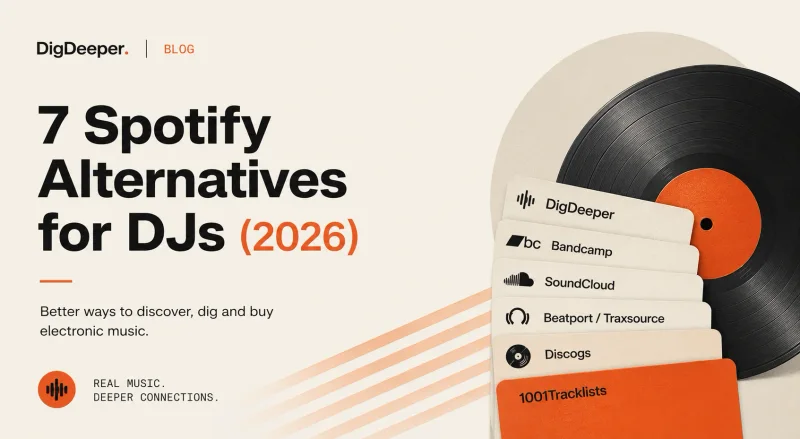
7 Spotify Alternatives for DJs (2026)
Spotify's algorithm wasn't built for DJs. Seven alternatives for finding electronic music: audio-similarity search, Bandcamp digging, vinyl archives. Tested in 2026.
13 min read