BlogComparisons
7 Spotify Alternatives for DJs (2026)
Spotify's algorithm wasn't built for DJs. Seven alternatives for finding electronic music: audio-similarity search, Bandcamp digging, vinyl archives. Tested in 2026.
 Antonio Haas14 min read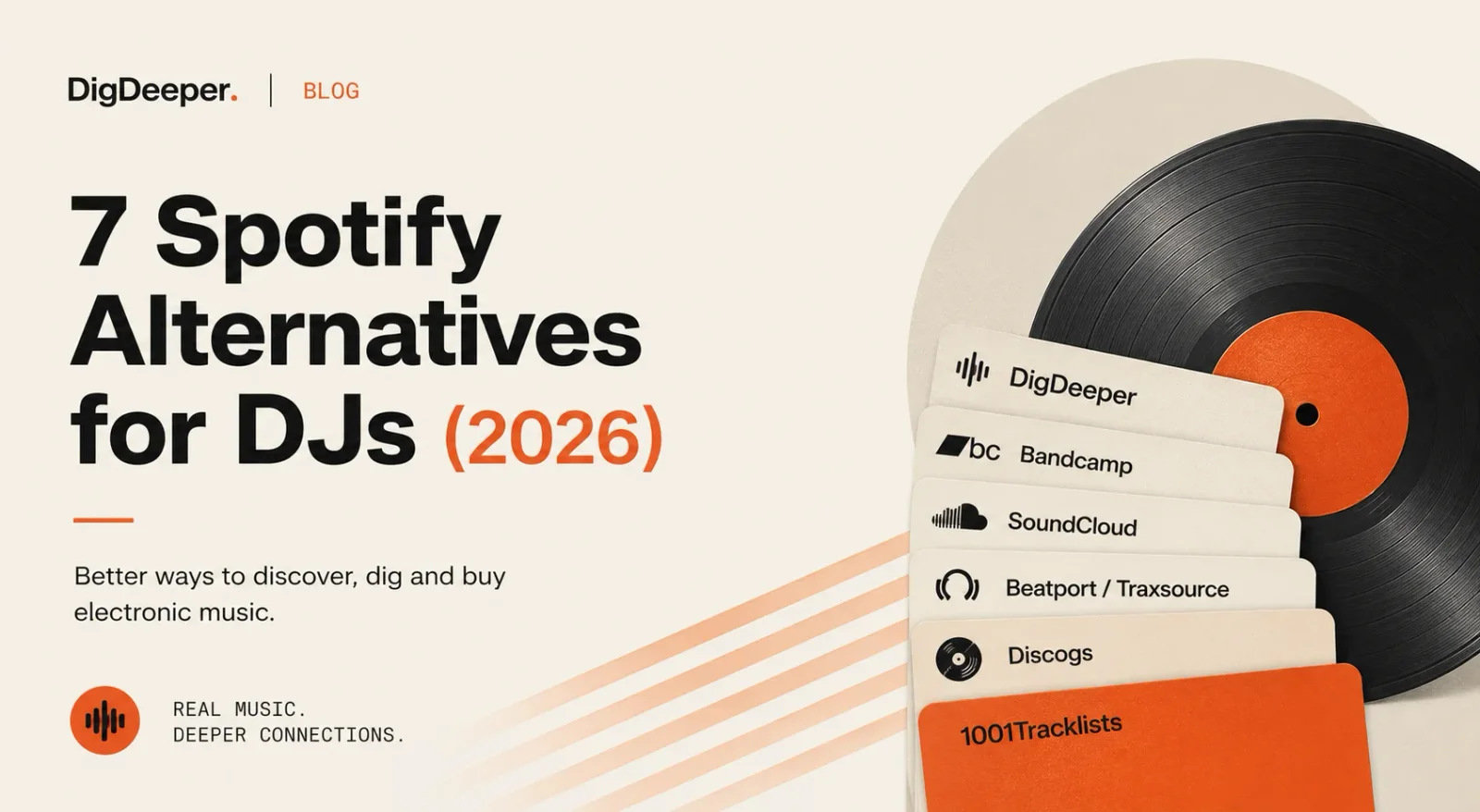
TL;DR
If you just want the short answer: the three best Spotify alternatives for DJs in 2026 are DigDeeper (find tracks that sound like a reference track, by audio rather than tags), Bandcamp (buy underground releases directly from artists and labels), and SoundCloud (unreleased edits, bootlegs and small producers). Which one you reach for depends on the job: DigDeeper for finding more of a specific sound, Bandcamp for buying and supporting the scene, SoundCloud for what's not officially out yet. The other four on this list (Beatport/Traxsource, cosine.club, Discogs and 1001Tracklists) each cover a job Spotify simply doesn't do.
On this page
- Why DJs are looking beyond Spotify in 2026
- The 7 alternatives at a glance
- 1. DigDeeper: find similar tracks by sound, not genre
- 2. Bandcamp: where the underground actually releases music
- 3. SoundCloud: unreleased tracks, edits and tomorrow's producers
- 4. Beatport & Traxsource: the DJ record stores
- 5. cosine.club: free audio-similarity search with a vinyl soul
- 6. Discogs: the deep end of the crate
- 7. 1001Tracklists: dig through what the DJs you rate actually played
- How to choose
- How we tested
Last updated: July 13, 2026 · By Antonio Haas — digging electronic music since he was 16, house DJ (as Tonee) on vinyl and digital, co-founder of DigDeeper
One thing up front: this isn't a "Spotify is dead" post. Spotify is fine for listening on your commute. It's just not built for DJs. And since July 1, 2020, when Spotify cut off all third-party DJ apps, you can't even use it in DJ software anymore. What DJs need is a way to go from "I love this track" to "here are 50 more that hit the same way." That's exactly where the algorithm falls apart.
Why DJs are looking beyond Spotify in 2026
Three reasons come up again and again, in our user interviews and across DJ communities:
1. The algorithm shows everyone the same tracks, and it gets worse the deeper you dig. Spotify, Apple Music and every mainstream service recommend music through behavioral algorithms: they predict what you'll play based on what millions of similar listeners played. That works well for mainstream genres, where there's a mountain of listening data to learn from. But the more niche your taste gets — and a working DJ's taste profile is niche by definition — the thinner that data becomes, and the recommendations degrade toward safe averages. The algorithm never listens to the music itself; it only watches user behavior. As one DJ put it on r/spotify: "Discover Weekly, DJ, Release Radar, Radio... It's all the same algorithmic crap. Spotify's algorithms are tuned to pigeon hole you into a corner." If you're playing what an algorithm hands out to millions of listeners, you're playing what every other DJ is playing.
2. The catalog is drowning in filler. Spotify's co-CEO said in April 2026 that the library now holds roughly 250 million tracks, including machine-generated content (Digital Music News); the long-standing official figure was "over 100 million." Users have noticed: complaints about AI-generated tracks flooding recommendations are now a recurring topic on r/truespotify. More catalog hasn't meant more relevance. As one r/electronicmusic user wrote (85 upvotes): "I feel so lost in a sea of electronic music."
3. Underground electronic music often isn't there at all. White labels, Bandcamp-only releases, vinyl-only pressings, unreleased edits. A significant share of what actually gets played in clubs never touches Spotify. Tommy, one of the DJs we interviewed for this piece, summed up his experience with mainstream recommenders: "Spotify or Apple Music, even Shazam recommendations only get 1 or 2 out of 6 right at best."
In November 2024, Spotify also shut down API access to its recommendation and audio-features endpoints for new apps, which quietly broke or froze a whole generation of third-party discovery tools that were built on Spotify's metadata. The tools below don't have that problem: none of them depend on Spotify's data.
The 7 alternatives at a glance
| Tool | Best for | How discovery works | Price (July 2026) |
|---|---|---|---|
| DigDeeper | Finding tracks that sound like a reference track | Audio analysis of the actual sound, ranked by similarity | Free (5 searches/mo) · Pro €9.99/mo |
| Bandcamp | Buying underground releases, following labels | Manual digging, label/artist follows, fan collections | Free to browse; pay per release |
| SoundCloud | Unreleased tracks, edits, DJ sets | Stations, likes-chains, artist follows | Free (with ads) · Go ~$4.99/mo · Go+ ~$10.99–12.99/mo |
| Beatport / Traxsource | Buying club-ready files in full quality | Charts, label pages, DJ charts | Pay per track (~€1.49–2.99) |
| cosine.club | Free audio-similarity search for vinyl diggers | Audio analysis, ~1.9M tracks, mostly vinyl | Free |
| Discogs | Vinyl deep-digging, back catalogs | Marketplace browsing, want-lists, credits | Free to browse; marketplace prices |
| 1001Tracklists | Finding what DJs actually played | Set tracklists, track-ID community | Free (ads) |
(Prices checked July 2026. See changelog at the end for updates.)
1. DigDeeper: find similar tracks by sound, not genre
DigDeeper is an audio-similarity search engine for electronic music. You drop in a reference track (a YouTube, SoundCloud or Bandcamp link, or a search in the catalog) and get up to 100 acoustically similar tracks, each ranked with a similarity score from 0 to 100 %. A deep audio model listens to the actual sound: rhythm, bass weight, drum patterns, harmonic texture, atmosphere. No genre tags, no popularity signals, no behavioral profile. That's why a 1994 jungle B-side and a 2024 release can match at 94 %, even if their tags have nothing in common.
Unlike Spotify's recommendations, DigDeeper doesn't guess your taste from listening history. You pick the reference; it finds the matches. The catalog holds over 11 million electronic tracks (11,094,530 as of July 13, 2026) aggregated across Bandcamp, Traxsource and the vinyl shops Decks.de and Deejay.de, including roughly a million vinyl-only tracks that streaming services have never indexed.
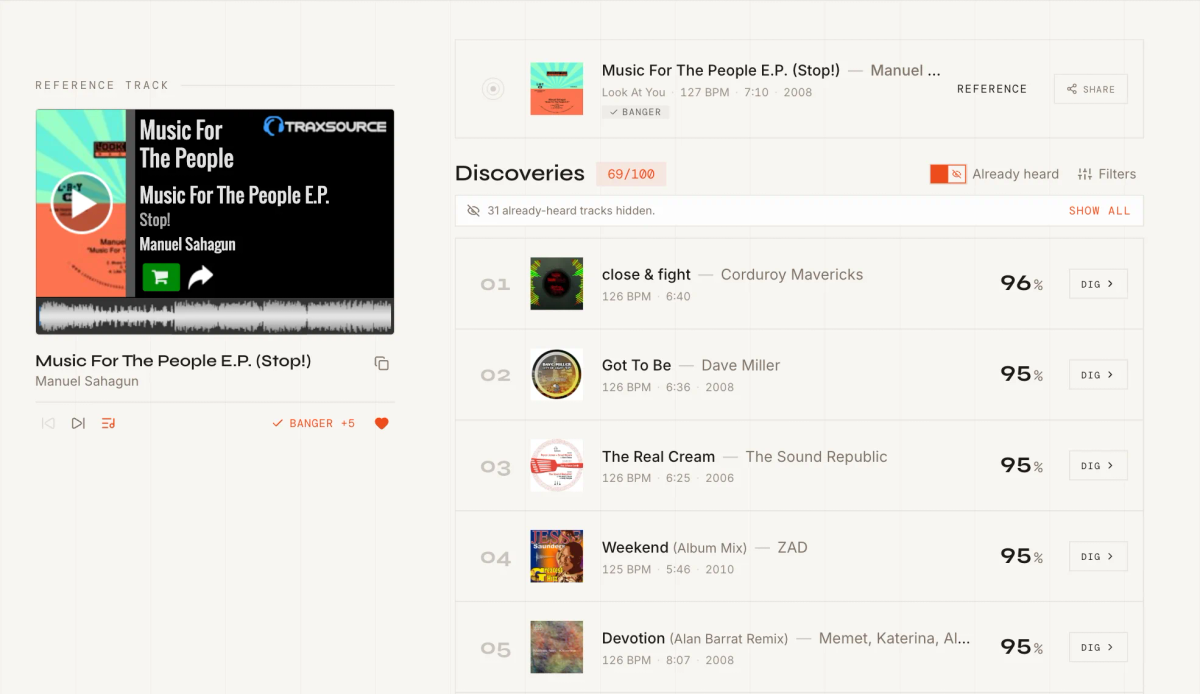
The feature DJs end up using most is the rabbit-hole mechanic: from any result you can hit Dig This Track (100 closest matches in the whole library), Dig This Label (every track on that label, ranked by similarity) or Dig This Artist. For set prep, results filter by BPM range, track length and format (digital/vinyl). A Camelot wheel key filter highlights the harmonically safe moves from your source key, so the matches don't just fit the vibe, they fit the transition. Every result shows all the stores where the track is available, so you can go straight from finding it to buying it in full quality.
What that adds up to is a fast way into a sound you want to explore. Traditional digging maps a scene through its connections: this artist released on that label, that label shares a roster with this one. Searching by sound skips the family tree entirely: you find artists and labels making exactly the music you're after even when they have no connection to anything you already know. Different country, different era, different corner of the scene. Those disconnected corners are where the tracks nobody else in your city is playing tend to live.
Pros:
- Finds tracks by how they sound, which is the exact use case ("more like this one") where Spotify's algorithm fails
- Deep underground coverage: Bandcamp, digital stores and vinyl in one index, with buy links on every result
- Set-prep tools built in: BPM, length and Camelot key filtering, hide-already-heard, playlists
Cons:
- Electronic music only. If you play open-format or Top 40, this isn't your tool
- Fresh URLs that aren't in the catalog yet take 10–30 seconds to analyze (catalog tracks return in 1–2 seconds)
Price: 3 anonymous searches free, no signup. Free tier: 5 searches/month, full feature set. Pro: €9.99/month, unlimited searches, 14-day free trial without a card. (Full disclosure: DigDeeper is our tool. The cons above are real, and the rest of this list is genuinely worth your time.)
2. Bandcamp: where the underground actually releases music
Bandcamp is the closest thing electronic music has to a home base. Artists and labels upload directly, set their own prices, and keep the majority of revenue. For entire corners of the underground, a release "exists" when it's on Bandcamp, often months before (or instead of) any streaming service.
The digging workflow is manual: follow labels and artists, check what other buyers of a record also bought, crawl through genre tags. That manual-ness is both the charm and the cost. Vicente, a minimal house DJ who uses both Bandcamp and DigDeeper, describes the reality: Bandcamp is where his trusted labels live, but browsing means "many tabs," no keyboard navigation, and "out of a hundred tracks, maybe I pick two." His workflow: dig Bandcamp for the anchor track, then run it through a similarity search to fan outward.
Pros: direct artist support, lossless downloads, the deepest underground catalog anywhere, fan-collection browsing. Cons: search and discovery are notoriously weak, genre tags are whatever the uploader typed, and digging takes hours by design. Price: free to browse; you pay per release (typically €1–10 digital).
3. SoundCloud: unreleased tracks, edits and tomorrow's producers
SoundCloud is where music appears before it's "out." Unreleased edits, bootlegs, radio rips, demos from producers with 200 followers. If a track technically shouldn't be purchasable yet, it's probably on SoundCloud. It's also one of the few places to listen to full DJ sets and mixes, which streaming services mostly can't host for licensing reasons. Stations and likes-chains (open a track you love, crawl the likers' profiles) can genuinely surface heat.
The pain points are just as established: search is unreliable, takedowns kill links, and the recommendation loop starts repeating itself quickly. "After a while they just keep recommending tracks I already know" is a near-universal experience, echoed across r/DJs. Pros: unreleased material, full DJ sets and mixes, direct artist contact. Cons: broken search, dead links, quality varies wildly, recommendations loop, free tier interrupts listening with ads. Price: free with ads; Go ($4.99/mo) removes ads and adds offline listening; Go+ ($10.99–12.99/mo depending on region) adds the major-label catalog and higher audio quality.
4. Beatport & Traxsource: the DJ record stores
Beatport and Traxsource are where DJs buy club-ready files. Full-quality downloads, proper metadata, label pages, and genre charts that at least attempt DJ-relevant curation (Traxsource especially for house and its tributaries).
And to be clear on the pricing: paying per track isn't a downside here, it's the point. Streaming doesn't give you files. If you're playing on a proper system, you need the full-quality download, and that's exactly what these stores sell.
The catch is the charts. Sales-ranked charts mean everyone sees, and plays, the same tracks. The sentiment on r/Beatmatch is blunt: "man, f beatport charts! u gotta dig!" (104 upvotes). Or, from r/DJs: "99% of Beatport IS garbage. Job #1 of every DJ is weed out the garbage and find the gems. That's 80% of the work." Beatport is an excellent store and a mediocre discovery engine. Use it for the former. Pros: full-quality club-ready files you actually own, reliable metadata, label browsing. Cons: chart homogeneity, discovery means wading through a lot of filler. Price: ~€1.49–2.99 per track.
5. cosine.club: free audio-similarity search with a vinyl soul
cosine.club is the other audio-similarity search engine. If this article were only allowed one honest sentence about it, it would be: it's good, and it's free. Built by the team behind the hurfyd YouTube channel and covered by Resident Advisor and Mixmag, it analyzes audio the same fundamental way DigDeeper does. Its catalog is around 1.9 million tracks with a clear vinyl focus and a house lean — you can even filter results by release year and by how many Discogs users have a record in their collection, which tells you exactly who this was built for: wax diggers.
Where the two differ is scope and workflow. Cosine's catalog is a fraction of the size (1.9M vs. 11M+ tracks) and less diverse across electronic genres; because so much of it is vinyl-only, many of the tracks you find there can't be bought digitally at all. DigDeeper covers vinyl and digital, shows every store where a track is available, and lets you filter by format — so if finding a track you can actually buy in full quality matters to you, that's the deciding difference. On top of that come the set-prep filters (BPM, length, Camelot key) and the Dig This Track/Label/Artist rabbit hole. Tommy, who has used both: "There are platforms like Cosine.club, but they're not precise enough and tend to drift too much." Your mileage may vary. It's free, so run the same reference track through both and trust your ears.
Pros: free, real audio analysis, strong vinyl coverage, Discogs-collection and year filters, lovely lo-fi spirit. Cons: ~1.9M-track catalog with a house lean, less genre diversity, many finds are vinyl-only (no digital purchase), no set-prep filters. Price: free.
6. Discogs: the deep end of the crate
Discogs is the archive. The most complete database of physical releases in existence, plus a marketplace where the record you've hunted for three years is sitting in a seller's basement in Osaka. For back-catalog digging (following a producer's aliases, a label's full run, an engineer's credits) nothing else comes close.
It is also gloriously, brutally slow. One r/DJs user: "I just spend about 4 to 6 hours a day on Discogs. The frustrating part is the amount of shit you need to listen to before finally discovering an actual new good track." Pros: unmatched vinyl depth, credits rabbit holes, want-list culture. Cons: no audio previews for most listings (you're off to YouTube constantly), discovery is pure manual labor. Price: free to browse; marketplace prices vary.
7. 1001Tracklists: dig through what the DJs you rate actually played
1001Tracklists is the Wikipedia of dance music sets. Find the tracklist for that Essential Mix, Boiler Room or festival set, and mine it for IDs. It's the systematized version of the oldest discovery method there is: steal from DJs with better record collections.
The structural limit: you're always downstream. By the time a track is ID'd on a big set, a lot of DJs have it. It's a great starting point. Take the one track from the set that wrecked you, then use it as a reference to find what nobody's playing yet. Pros: free, huge set database, community track-IDing. Cons: you discover what's already circulating; ID-walls on unreleased tracks. Price: free with ads.
How to choose
Ask yourself what the actual job is:
- "I have one track I love and need more that sound like it" → DigDeeper (or cosine.club: try both, one's free and the other has a free tier)
- "I want to support the scene and own my music" → Bandcamp, with Beatport/Traxsource for club-ready files
- "I want what isn't released yet" → SoundCloud
- "I'm building a vinyl collection / digging back catalogs" → Discogs, cosine.club
- "I want to know what [DJ I rate] played" → 1001Tracklists, then feed the finds into a similarity search
- "I just want background music while I work" → honestly, keep Spotify for that
Most working DJs use three or four of these in a chain: hear something (radio, set, 1001Tracklists) → get the file or link → run it through a similarity search → buy on Bandcamp/Beatport. The tools on this list aren't really competitors. They're stages of the same dig.
How we tested
We ran the same reference tracks through every tool on this list in July 2026 and compared the results. Tools were tested on their current public versions.
Written by Antonio Haas, co-founder of DigDeeper and house DJ (Tonee) in the Mainz/Frankfurt scene. DigDeeper is our product, and we've kept the assessment of every tool on this list as factual as we can, cons included. Corrections welcome: hello@digdeeper.fm.
Changelog: July 13, 2026. First published.
Frequently Asked Questions
What is the best Spotify alternative for DJs?
There's no single answer, it depends on the job. For finding tracks that sound like a specific reference, an audio-similarity search engine like DigDeeper is the most direct replacement for Spotify's recommendations. For buying underground music, Bandcamp. For unreleased material, SoundCloud. Most DJs combine several.
Can you DJ with Spotify?
Not anymore. On July 1, 2020, Spotify shut off access for third-party DJ apps like djay, Pacemaker and Cross DJ, citing licensing restrictions, and never restored it. No major DJ software (Rekordbox, Serato, Traktor) can stream from Spotify. DJs need actual files, which is why stores like Beatport, Traxsource and Bandcamp are part of every serious workflow.
Why are Spotify recommendations bad for DJs?
Because they optimize for average listening behavior, not for a specific sound. Discover Weekly predicts what someone with your history will probably enjoy. It can't answer "give me 50 tracks that sound like this one." It also misses the underground: white labels, Bandcamp-only and vinyl-only releases often aren't on Spotify at all.
Is there a free Spotify alternative for DJs?
Yes, several. cosine.club is completely free. DigDeeper has a free tier (5 similarity searches a month, plus 3 anonymous searches without signup). Bandcamp, Discogs, SoundCloud and 1001Tracklists are all free to browse.
What do DJs use instead of Discover Weekly?
Reference-based search. Instead of letting an algorithm guess from your history, you pick one track that has exactly the sound you want and search from there: via audio-similarity tools, label digging on Bandcamp, or mining tracklists on 1001Tracklists.
Written by
Antonio Haas
Digging electronic music since he was 16, house DJ (as Tonee) on vinyl and digital, co-founder of DigDeeper.
Search by sound
Drop a track you love. Hear what else sounds like it.
DigDeeper listens to the actual audio and finds the tracks that sound most similar.
Try DigDeeper FreeKeep digging
DJ Tips
Why Shazam Fails at Electronic Music (And What to Do When It Does)
Shazam fails on DJ mixes, unreleased tracks and white labels — here's why the algorithm can't help, what DJs do instead, and how to keep digging after the ID.
12 min read
DJ Tips
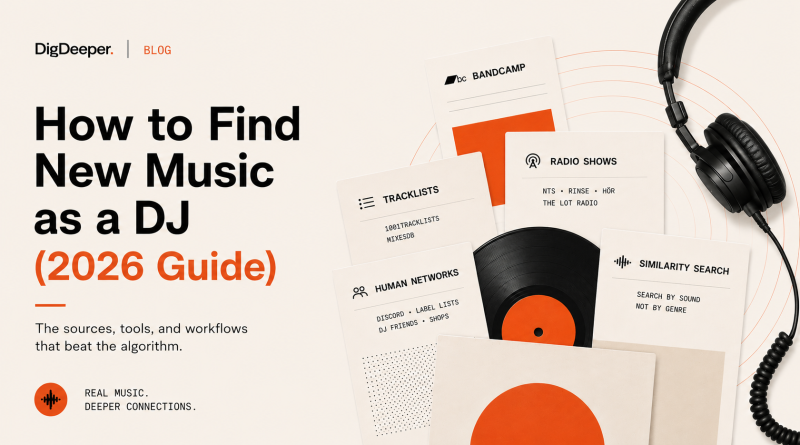
How to Find New Music as a DJ (2026 Guide)
How working DJs actually find new music in 2026 — the sources, tools, and workflows that beat the Spotify algorithm.
13 min read
Music Discovery
Why Spotify Discover Failed for DJs (and what we built instead)
Every DJ I know keeps the same graveyard on their account: a Spotify Discover playlist they stopped opening months ago. This is the story of why the algorithm kept missing for me, and what my co-founder Marc and I built in Mainz after one too many dead-end digging sessions.
8 min read